|
Danube River in Bulgaria hits historic low, mammoth remains unearthed
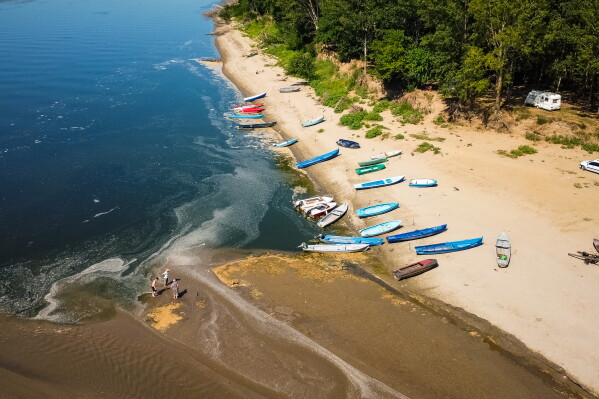
Danube River levels in northern Bulgaria reach a historic low, and the remains of a mammoth are discovered as the riverbed becomes exposed. The development brings attention to key geographical features of the Danube River and the Danube Delta.
Danube River:
| Dimension | Key Details |
|---|---|
| Length and rank (Europe) | It is the second-longest river of the European continent, after the Russian Volga River. |
| Total length | It flows for 2,850 km. |
| Source | It sources from the confluence of the Brigach and Breg rivers, close to the German town of Donaueschingen in the Black Forest region of Germany. |
| Countries traversed | It passes through 10 European nations: Germany, Austria, Hungary, Serbia, Bulgaria, Croatia, Slovakia, Moldova, Ukraine, and Romania. |
| Drainage and mouth | It ultimately drains into the Black Sea via the Danube Delta. |
| Danube Delta: area and location | The Danube delta covers an area of some 4,300 sq. km, and it is located in the Tulcea County of Romania. |
| Danube Delta: growth | It is comparatively young and continuously growing at a rate of 24 to 30 m annually towards the sea. |
| Danube Delta: UNESCO tag | It is a UNESCO World Heritage Site renowned for its rich biodiversity. |
| Major tributaries | The Danube is fed by major tributaries like the Inn, Drava, Sava, Tisza, Prut, and Siret. |
| National capitals on its course | The Danube River flows directly through four national capitals: Vienna, Bratislava, Budapest, and Belgrade. |
| Canal connectivity | Through the Rhine-Main-Danube Canal, it connects the North Sea at Rotterdam to the Black Sea at Sulina, forming a 3,500 km trans-European inland waterway. |