|
Rare Earth Permanent Magnet Scheme
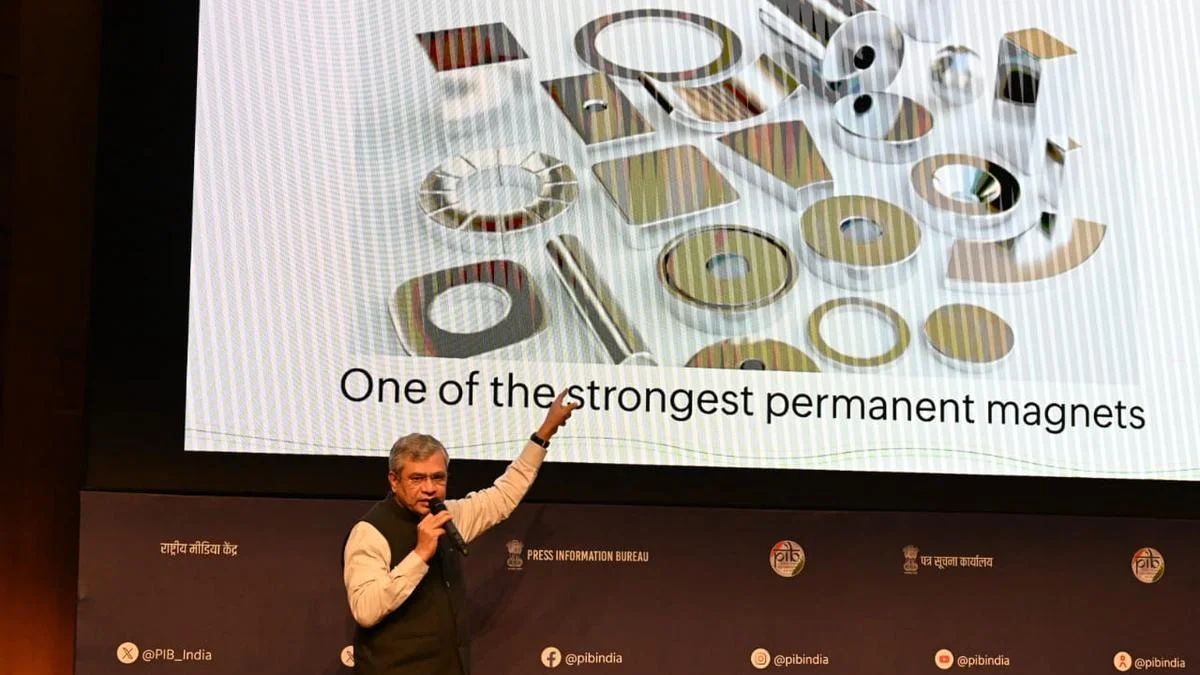
An assessment of Rare Earth Permanent Magnet (REPM) demand in India is done by IREL (India) Limited, Defence Metallurgical Research Laboratory (DMRL), and Bhabha Atomic Research Centre (BARC). A Rare Earth Permanent Magnet Scheme is in focus for building a domestic, fully integrated manufacturing ecosystem for high-strength sintered rare-earth permanent magnets and for reducing import dependence for sectors like electric vehicles and defense.
Rare Earth Permanent Magnet (REPM) Scheme:
| Dimension | Key Details |
|---|---|
| Focus | Provides for building a domestic, fully integrated manufacturing ecosystem for high-strength sintered rare-earth permanent magnets. |
| Financial outlay | Comprises a total budget of ₹7,280 crore: ₹6,450 crore for sales-linked incentives over 5 years and ₹750 crore as a capital subsidy. |
| Production capacity | Provides for creating a domestic capacity of 6,000 metric tonnes per annum (MTPA). |
| Allocation mechanism | Authorises division of 6,000 MTPA among 5 selected beneficiaries (up to 1,200 MTPA each) through a global competitive bidding process. |
| Scheme duration | Comprises a 7-year duration, including a 2-year gestation period for facility setup and 5 years of sales-linked incentive disbursement. |
| Integrated value chain mandate | Mandates building the complete domestic value chain: rare earth oxides, metals, alloys, and sintered finished magnets. |
| Value chain coverage | Supports the complete processing chain from raw rare-earth oxides to metals, alloys, and finished magnets. |
| Target sectors | Applies to sectors powered by REPMs: EV motors, wind turbines, electronics, aerospace, and defense equipment. |
| Demand projection | States that India's REPM demand is projected to reach 8,220 MTPA by 2030. |
| Key demand drivers | Comprises demand primarily driven by electric vehicles (3,250 MTPA), wind turbines (1,800 MTPA), BLDC fans (980 MTPA), and consumer electronics/smartphones (600 MTPA). |
| Import dependence | States that India currently imports around 90–95% of its rare earth permanent magnets, largely from China. |
| Strategic vulnerability | States that import dependence poses a supply chain risk for strategic defence systems (missiles, drones, and radars), clean energy transitions, and advanced electronics. |