|
Study Flags Khijadiya Bird Sanctuary as Black-necked Stork Breeding Hub
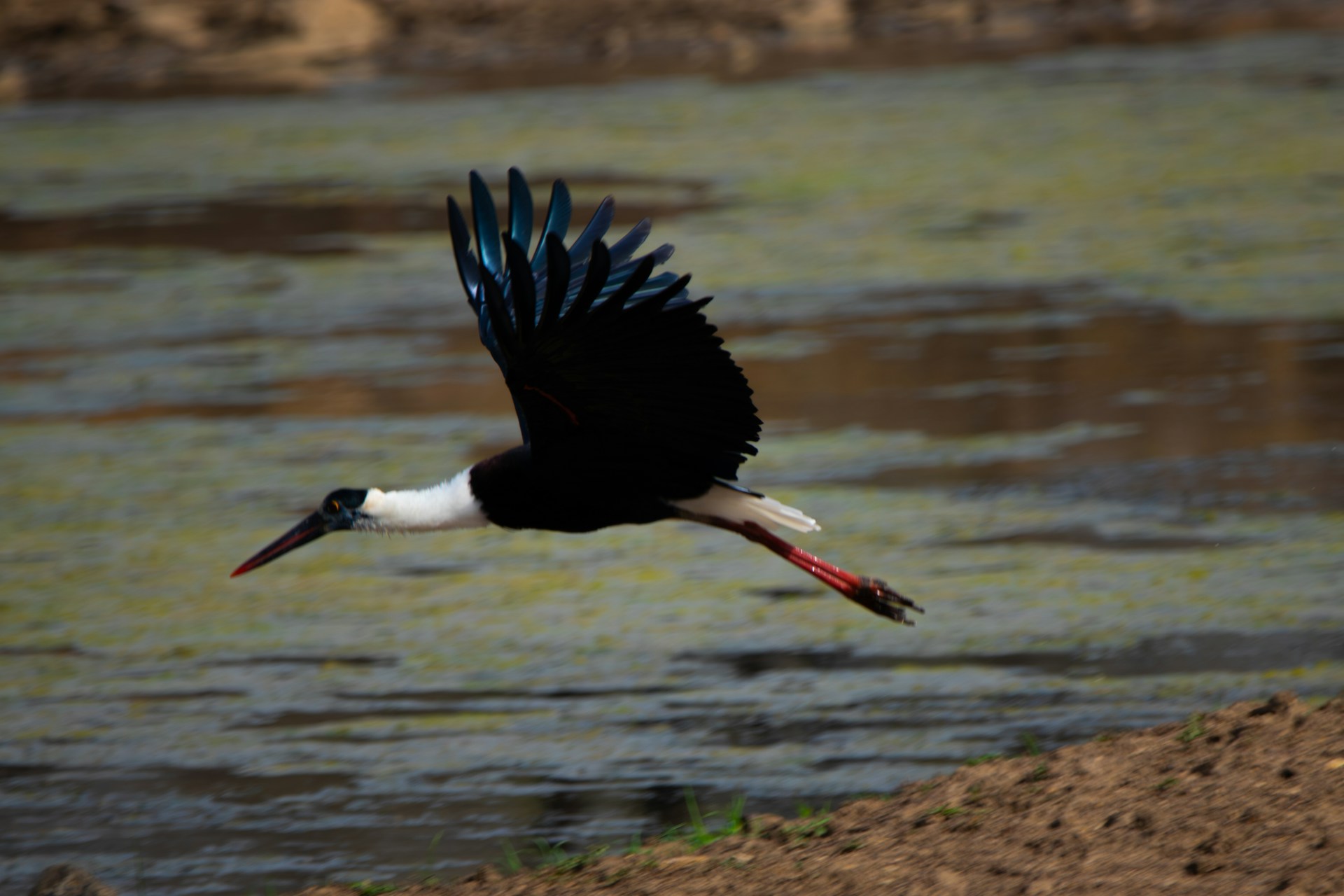
A study by the Gujarat Ecological Education and Research (GEER) Foundation identifies Khijadiya Bird Sanctuary in Jamnagar district, Gujarat, as a major breeding stronghold for the Black-necked Stork.
Black-necked Stork and Khijadiya Bird Sanctuary:
| Dimension | Key Details |
|---|---|
| Fledging Outcome | The study reports 100% fledging success across 4 monitored active nests, with 2 chicks raised per nest, totalling 8 new juveniles and zero recorded chick mortality, predation, or nest abandonment. |
| Peak Seasonal Population | The sanctuary supports a peak seasonal population of 21 to 23 Black-necked Storks, including breeding pairs, fledglings, and 5 non-breeding adults. |
| Nesting Substrate and Height | All 4 nests are constructed at heights of 3 to 4.5 metres on Neltuma juliflora, formerly Prosopis juliflora, locally known as gando baval. |
| Feeding Hydrology Linked to Nesting Success | Nesting success is driven by adjacent shallow, semi-perennial wetlands with water depths between 0.3 and 0.7 metres. |
| Diet Items Noted | The wetlands provide an abundant supply of fish, amphibians, crustaceans, and aquatic invertebrates. |
| Breeding Behaviour Observed | Adults attend nests for an average of 62 minutes per visit, and parents swap nest duty during foraging departures in 94% of observed instances. |
| Species Scientific Name | The Black-necked Stork is Ephippiorhynchus asiaticus. |
| Taxonomy | The Black-necked Stork belongs to the stork family Ciconiidae. |
| Identification Features | The Black-necked Stork is recognized by a contrasting black-and-white body, iridescent blue-green neck, long bright red legs, and a heavy black bill. |
| Habitat and Range | The species is native to South Asia, Southeast Asia, and Australia, preferring open freshwater marshes, shallow river courses, and semi-perennial wetlands. |
| IUCN Status | The IUCN Red List status of the Black-necked Stork is Near Threatened. |
| Legal Protection | Under the Wild Life (Protection) Act, 1972, the species is protected under Schedule II, as amended in 2022. |
| Sanctuary Location | Khijadiya Bird Sanctuary is situated in the Jamnagar district of Gujarat, along the coast of the Gulf of Kutch. |
| Unique Ecosystem Feature | The sanctuary comprises a unique eco-tone featuring both freshwater wetlands and saline/brackish habitats. |
| Man-made Feature | The sanctuary’s ecosystem is created by a man-made bund built to prevent seawater ingress into agricultural land. |
| Ramsar Designation | Khijadiya Bird Sanctuary has been designated as a Ramsar Site (Wetland of International Importance) in 2022. |
| Migratory Corridor | The sanctuary serves as a wintering and staging ground along the Central Asian Flyway for thousands of migratory and resident waterbirds. |