|
Supreme Court Bars States From Blocking Elephant Corridors
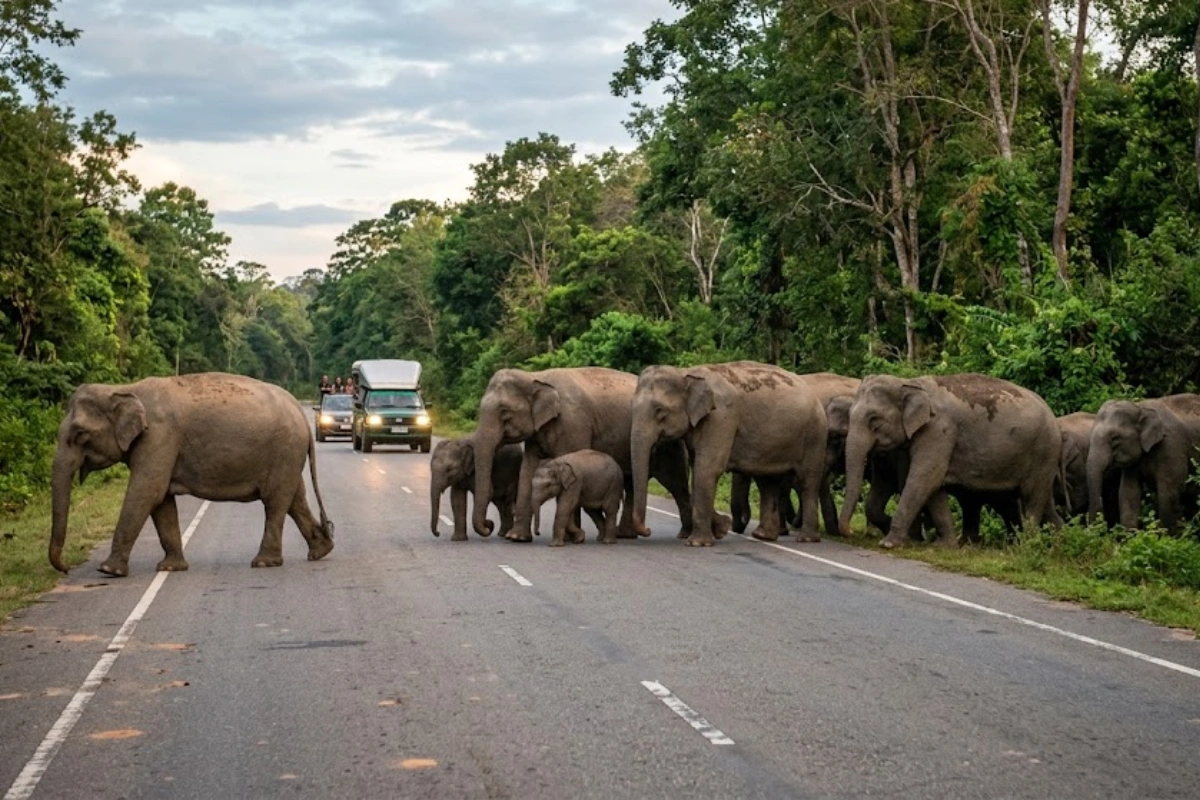
The Supreme Court directs states to not block elephant corridors. The Supreme Court also directs the Centre to conduct a nationwide survey on measures taken by states to prevent and prohibit “hula parties” and the use of fireballs, mashaals, etc. against elephants.
Supreme Court Directions and Human–Wildlife Conflict (HWC):
| Dimension | Key Details |
|---|---|
| Supreme Court direction | The Supreme Court directs the Centre to conduct a nationwide survey on measures taken by states to prevent and prohibit hula parties, use of fireballs, and use of mashaals against elephants. |
| Hula parties | Hula parties comprise groups of local youth armed with iron rods or spikes and burning mashaals. |
| HWC: Habitat loss and fragmentation | Habitat loss and fragmentation comprises elephants raiding paddy and sugarcane fields in Assam and Karnataka. |
| Forest cover loss | India lost 1.6 million hectares of forest cover between 2000 and 2020, disrupting vital wildlife corridors. |
| HWC: Encroachment into wildlife corridors | Encroachment into wildlife corridors comprises speeding trains in elephant crossing areas, electrocution by low-hanging wires, and poisoning of crops. |
| HWC: Decline in natural food and water | Decline in natural food and water, including due to climate change, comprises leopards entering villages in Uttarakhand in search of food. |
| Consequence: Leopard deaths | Human activity causes over 1,000 leopard deaths between 2015 and 2020. |
| Consequence: Economic losses | Crop damage is the most prevalent conflict type, and crop raiding by elephants in Odisha alone causes an estimated $10 million in annual losses to farmers. |
| Consequence: Human deaths | Attacks by elephants kill more than 500 people every year, with Odisha, Jharkhand, and Assam being the most affected. |
| MoEFCC guidelines (2023) | MoEFCC in 2023 issues guidelines for mitigation of conflicts arising from various wild animals: Elephant, Gaur, Leopard, Snake, Crocodile, Rhesus Macaque, Wild Pig, Bear, Blue Bull, and Blackbuck. |
| Centrally Sponsored Schemes | Centrally Sponsored Schemes comprise Development of Wildlife Habitats, Project Tiger, and Project Elephant, where financial assistance to States and UTs is provided. |
| National Wildlife Action Plan | The National Wildlife Action Plan 2017-2035 includes a dedicated chapter on managing HWC. |
| National HWC Mitigation Strategy and Action Plan | The National Human-Wildlife Conflict Mitigation Strategy and Action Plan (2021-26) ensures harmonious co-existence and overall well-being of humans and wildlife. |
| Regional action plan | The Regional Action Plan for Comprehensive Understanding and Management of Human–Elephant Conflict in Southern India applies to Karnataka, Keralam, Andhra Pradesh, and Tamil Nadu. |
| Technology used | Advanced technology used in human-wildlife conflict mitigation comprises radio collaring and E-surveillance. |